 AmongUsBase
In the hallowed halls of PlayStation's elite first-party pantheon, Naughty Dog sits upon an iron throne forged from shattered loading screens, perfectly rendered snowflakes, and impossibly lifelike ropes. Even in 2026, the industry still gasps at the studio's pathological inability to accept the word "good enough." Every pixel, every particle, every strand of hair that shivers in a Himalayan blizzard has been tortured into submission by artists who clearly view mere reality as a disappointing starting point. This is not a developer that makes video games; this is a cabal of digital alchemists who transmute raw code into experiences so immersive that players occasionally forget to breathe.

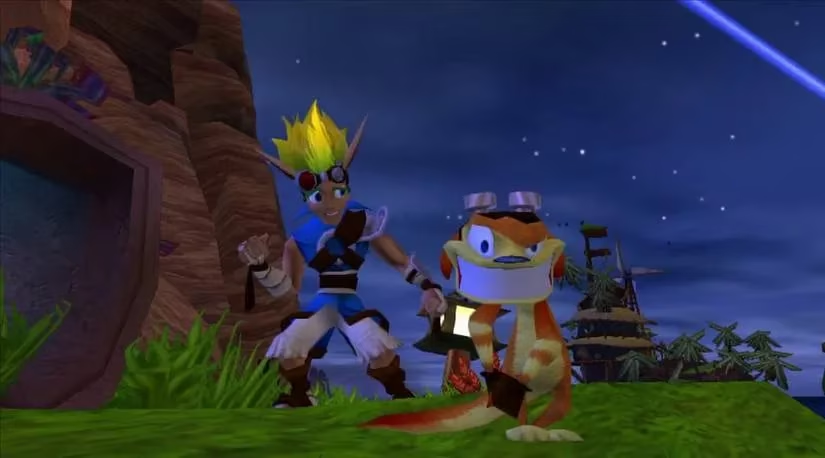
Cast your memory back to the primordial swamp of 2001, an era when consoles wheezed through loading screens with the grace of an asthmatic warthog. Naughty Dog, freshly acquired by Sony and desperate to birth a true PlayStation icon, unleashed Jak and Daxter: The Precursor Legacy upon an unsuspecting world. What did this colorful platformer do that made jaws unhinge? It completely obliterated loading screens. In an open-world game. In 2001. Without SSDs. The sheer audacity still makes veteran developers weep into their energy drinks. Co-founder Andy Gavin later confessed the dark magic behind this feat: the team sliced the game world into memory chunks with surgical precision, ensuring players could never peek at more than two chunks simultaneously. Borders hid behind twists, doors, and vast distances—tricks so devilishly clever that modern blockbusters still shamelessly steal them. When a 2026 release forces you to crawl through a suspiciously narrow crevice or ride an elevator that takes just a moment too long, you're experiencing the ghost of Naughty Dog's 2001 genius. Jason Rubin, now steering virtual reality experiences at Meta, admits he still obsesses over every millisecond of load time because "those things still matter." Indeed, in the blink-and-you're-impatient 2020s, the studio's ancient wizardry remains the gold standard.
Fast-forward to the 2009-2011 period, where Naughty Dog's pathological perfectionism turned its gaze upon weather itself. The Uncharted series, helmed by the visionary Amy Hennig, transformed Nathan Drake from a cocky treasure hunter into a living barometer. For Uncharted 2: Among Thieves, the studio didn't just render snow; they became meteorologists who decided God hadn't tried hard enough. Snowflakes accumulated realistically on Drake's hair and clothing, then melted when he stepped indoors. Footprints deformed drifts with believable weight. Wind sculpted powder into hypnotic patterns. Richard Lemarchand, a design lead at the time, described the exhaustive focus on "the distinctive look that snow has as it falls and is blown by the wind." Features that were revolutionary in 2009 now sit comfortably in every AAA toolkit, but no one forgets who drew the blueprint.
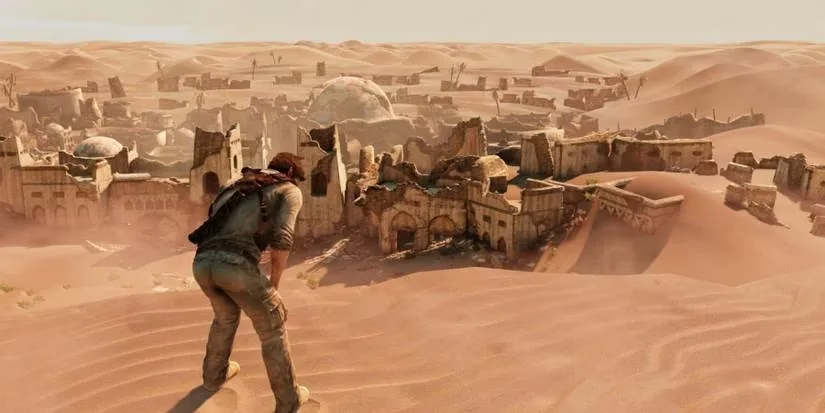
Then came sand. For Uncharted 3: Drake's Deception, the team decided an entire desert should behave like a fluid nightmare. Rendering countless individual particles that shift, slide, and respond to a character's weight is computational hell—and Naughty Dog sprinted into the flames. Employees famously trekked to the Imperial Dunes near Yuma to study sand as if preparing a PhD dissertation. The result was granular sorcery: sand that flowed downhill, swallowed footsteps, and behaved with a believability that bordered on insulting to actual physics. Competitors watched in dismay, realizing they would now have to sand-study too.
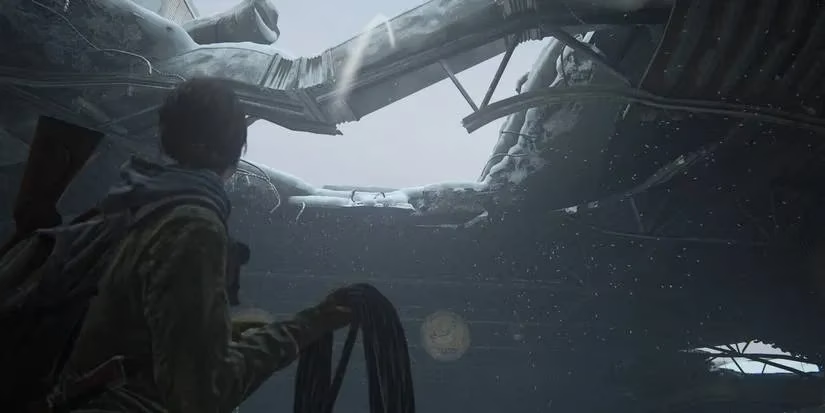
Then came 2020 and The Last of Us Part II. Oh, what a glorious storm of controversy, tears, and 300+ Game of the Year awards. But beyond the narrative gut-punches lay a technical marvel that strained the very limits of the PlayStation 4. Specificaly, the rope. Simple, humble rope. Naughty Dog programmer Jaroslav Sinecky revealed the studio had toiled on rope physics since Uncharted 4's pre-production in 2011—a full nine years of obsession for something most developers would slap with a stiff animation and call finished. The resulting tech allowed ropes to coil, swing, wrap around objects, and obey real-world expectations so faithfully that players could solve puzzles using genuine intuition rather than video game logic. "We really just only scratched the surface," Sinecky admitted, a statement that chills the spine because it implies there are rope secrets still locked within Naughty Dog's vaults, waiting to be unleashed in a future project.
In 2026, the industry stands on Naughty Dog's shoulders. Every dynamic weather system, every seamless open world, every physics-based puzzle owes a debt to this studio's refusal to compromise. The long-awaited The Last of Us multiplayer experience suffered a famous cancellation, but the technologies forged in that crucible have scattered like seeds into other projects. Whispers of a new IP—possibly shrouded in the studio's signature secrecy—suggest whatever comes next will again recalibrate our understanding of digital realism. Developers across the globe sleep uneasily, knowing Naughty Dog is somewhere polishing blades of grass until they bend with correct tensile strength.
And that's the beautiful curse of Naughty Dog. They make players wait an eternity. They agonize over details 99% of humans will never consciously notice. But when the software finally boots, the world becomes a little less real, and the game becomes a little more alive. The loading screen died in 2001 because Naughty Dog killed it. Snow became a character in 2009. Sand became a fluid in 2011. Rope became a physics thesis in 2020. What obsession will they inflict upon the PlayStation 5's successor? What particle will they chase until it weeps? The year 2026 holds its breath, knowing the next innovation will be absurdly meticulous, borderline insane, and absolutely industry-shifting. Naughty Dog doesn't just push technology forward—they drag it, kicking and screaming, into a future where perfection is merely the starting point. 🧗♂️🔬❄️
Technical breakdowns are echoed by Digital Foundry, whose frame-time and image-quality analyses help contextualize why Naughty Dog’s “invisible” wins—seamless streaming, dense environmental simulation, and physically plausible interactions—feel so transformative in practice. Looking at the studio’s legacy through a performance lens clarifies the trade-offs behind those signature moments: effects that read as effortless on-screen are often the result of ruthless budgeting across CPU, GPU, memory, and streaming, ensuring that ropes, sand, and snow remain responsive without collapsing into stutter or pop-in.