 AmongUsBase
I’ve spent countless hours in the shadowy corners of social deduction games, where every glance feels like a coded message and every sudden silence is a confession. When Killer in the Cabin first emerged from the Norwegian studio Games People Play, I knew I was witnessing something that would etch itself into my weekend gaming rituals. It’s now 2026, and the game has grown from a promising early access title into a weathered, creaking cottage of cunning and panic that I still crawl back to.
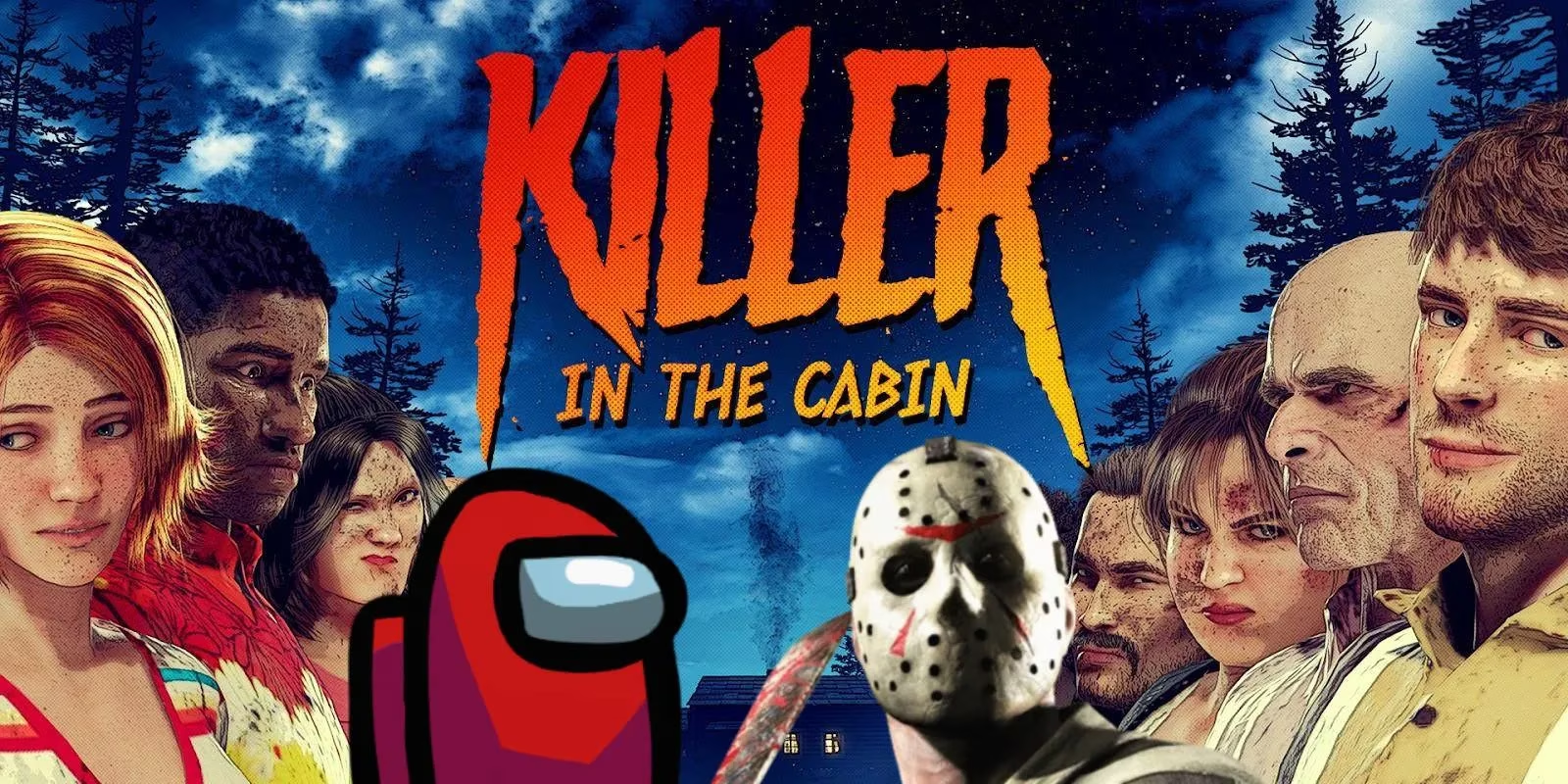
The first time I stepped into that frigid alpine cabin, I felt like I had wandered into a fever dream stitched together from my favorite horror films. The developers, former minds behind Block N Load and Battlestar Galactica Online, didn’t just clone Among Us with a fresh coat of paint; they built a whole organism. Where Among Us thrives on bright, cartoonish panic, Killer in the Cabin wraps you in a damp, earthy dread. It’s the difference between a child’s pop-up book of suspicion and a weathered diary found under a floorboard. The game demands a microphone, not because it’s trendy, but because voice chat is the coppery taste of paranoia in your mouth. Every word you speak echoes through the shared cabin space, and a single misplaced syllable can unravel you like a loose thread on a sweater, each tug revealing more of the hidden truth beneath.
I still remember the closed beta back on Halloween 2021, a 24-hour window that felt like a séance. Five of us were strangers, our voices crackling with uneasy politeness. The first kill was almost poetic—a teammate quietly poisoned a fish with cyanide, then watched another player use it to cook a communal stew. There was no red flag, no emergency meeting button. Just a simmering pot of betrayal. That’s when I realized Killer in the Cabin operates on a different metabolic level. Hunger and sleep aren’t just flavor text here; they’re survival mechanics that force you into vulnerable rituals. I once faked exhaustion to see who would approach me while I \u201cslept,\u201d only to feel the controller vibrate with a pair of hands tightening around my throat. In that moment, the game felt less like a whodunit and more like a wildlife documentary where the prey starts to write the script.
Over the years, the full release in 2022 and the steady drip of updates have layered the experience with even more nuance. The developer added new cabin layouts, weather conditions that distort sound, and tools that let the innocent frame others in subtle ways. Each match, which still runs about fifteen minutes, is a compressed lifetime of alliance and deception. I’ve seen friendships fracture over a misplaced axe and then mend over a shared victory against the real killer. The community adopted a lexicon all its own—\u201csnow-tracking\u201d for following footprints, \u201ctinder-talk\u201d for the desperate small chat survivors use to fill suspicious silence.
What fascinates me most is how the game handles the killer’s psychology. Success isn’t about razor-sharp reflexes; it’s about maintaining an emotional camouflage. You must be present enough to seem helpful but absent enough to avoid scrutiny, like a spider feeling the edges of a web it built from laughter and shared tasks. I once played a round where the killer spent the entire game baking virtual bread with another player, only to garrote them in the pantry during the final minute. The victim’s stunned silence over voice chat was more chilling than any scripted jump scare. That’s the magic of Killer in the Cabin—it understands that the most terrifying monsters wear a warm smile and offer you a bowl of poisoned soup.
By 2026, the game hasn’t dethroned Among Us as the casual king of social deduction, but it has carved out a darker, more intimate niche. It’s the lodge you visit when bright space stations feel too sterile. While other titles like Friday the 13th: The Game moored themselves to legal nightmares, Killer in the Cabin sailed on with its own identity, free from iconic masks and machetes. The tension here is handmade—creaking floorboards, a blizzard outside the window, the simple terror of watching a friend’s character die in their sleep because nobody kept watch. Trust becomes a threadbare blanket in a room with a draft, and every match asks you to pull it tighter, even as you feel it fraying.
I keep returning to that cabin because it mirrors something essential about human connection. We all perform versions of ourselves under social scrutiny, but in Killer in the Cabin, the performance has a body count. The game’s longevity proves that we crave not just the puzzle of guilt, but the texture of fear itself. So if you’ve never sat in a digital lodge with four friends, listening to the wind howl and wondering which of you is the wolf in the fold, I can only say: light no fire, watch every shadow, and never be the first to fall asleep.