 AmongUsBase
At its core, Among Us remains a remarkably streamlined social deduction experience. Its genius lies not in complex mechanics but in the tension between the visible tasks of crewmates and the hidden sabotage of imposters. For a long time, venting was a nearly perfect tool for the imposter: instant traversal across the map with no immediate consequence. The 2021.3.30 update changed that. It introduced a vent-cleaning task that let crewmates seal vents, forcing imposters to think twice before crawling through ducts. How could such a small addition reshape an entire metagame? The answer lies in the balance between mobility, information, and risk.

The Original Venting Problem
Before the update, an imposter inside a vent suffered no immediate penalty. They could wait indefinitely or slip into any connected room without being seen. Crewmates had no way to block the system. The only counter was observing the act of venting itself, which immediately exposed the imposter because only imposters can use vents. Still, a patient player could use vents to ambush, escape, and avoid detection. This created a frustrating dynamic: a skilled imposter could dance between vents, vanish after a kill, and reappear on the other side of the map before anyone could piece together what happened.
Did crewmates have any real defense? Not really. Their only hope was catching the imposter mid-vent, which required perfect timing and a bit of luck. Because of this, venting often felt like an all-reward, low-risk tool for the imposter. The gameplay remained fun, but it lacked a meaningful way for crewmates to push back against the duct network.
The Vent Cleaning Task
The 2021.3.30 update added a dedicated task: crewmates can now clean vents at specific locations. Once a vent is cleaned, imposters cannot use it, effectively blocking off instant access to that room. More dramatically, if an imposter happens to be inside a vent when it is cleaned, the imposter is forcefully ejected from the vent. This creates a new layer of punishment. No longer can an imposter simply camp in the ductwork, waiting for the perfect moment to strike.
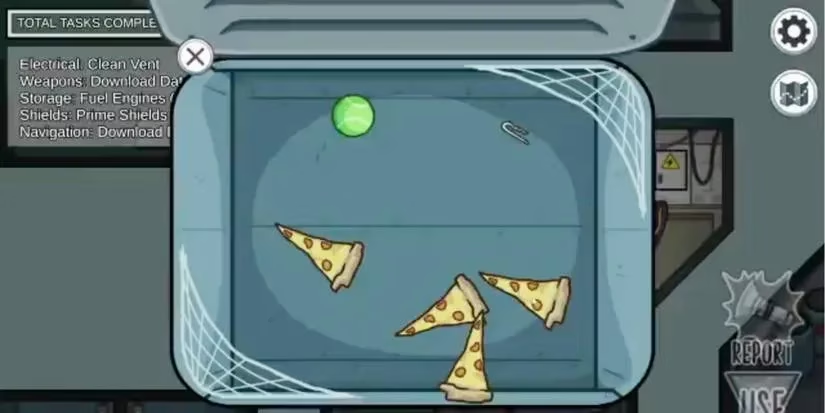
The beauty of this mechanic is its simplicity. It does not overhaul the whole game. Instead, it adds a small house rule that makes sense within the existing loop. Crewmates already move around the map completing tasks. Cleaning a vent feels like a natural extension of that routine. It gives them a tangible way to influence the imposter's mobility without introducing complicated new systems.
Strategic Implications for Crewmates and Imposters
For imposters, vent usage becomes a calculated risk. Which vents are safe? Has the crewmate in Electrical completed the cleaning task? Should an imposter fake a cleaning task to blend in? These questions add depth without making the game harder to learn. An imposter who ignores vent cleaning may find their escape route blocked at the worst possible moment. One who pays attention can use the mechanic to their advantage by claiming to have cleaned a vent, building false trust.
For crewmates, cleaning vents offers temporary security while completing multi-step tasks in isolated rooms. But cleaning a vent takes time, and the crewmate is vulnerable while standing at the task. This creates a trade-off. Is it worth spending precious seconds to secure a room? What if the imposter is nearby, waiting for the crewmate to finish? These small decisions make every match feel more dynamic.
| Role | Before Update | After Vent Cleaning |
|---|---|---|
| Crewmate | Could only watch for venting | Can permanently disable vents |
| Imposter | Could vent freely and camp | Risk ejection; must track clean status |
Why Small Mechanics Matter in 2026
Many players initially believed that Among Us could not improve much beyond new maps and cosmetics. After all, the core loop was already so tight that extra mechanics might have felt unnecessary. Yet the vent-cleaning update proved otherwise. It did not change the fundamental way the game is played. It simply opened up another dimension of strategy. By 2026, this mechanic has become a staple of the meta. Newer maps since The Airship have continued to integrate vent access points, and players now expect some form of vent sabotage or cleaning as part of the core loop.
Could Innersloth have gotten away with doing less? Perhaps. The game's popularity was already enormous. But their commitment to subtle gameplay innovation has kept Among Us relevant long after its initial surge. A small, intuitive change like vent cleaning shows that even the simplest games can evolve in meaningful ways. The duct network is no longer a free escape hatch. It is a contested space, a small battlefield where preparation meets opportunity. That tension is exactly what keeps a social deduction game alive.