 AmongUsBase
I still remember the wave of excitement that rippled through the gaming community back in early 2022, when Bessatsu CoroCoro announced they were turning the minimalist whodunnit chaos of Among Us into a full-fledged manga series. At the time, the game was still riding the explosive popularity it gained during the pandemic, and the idea of giving those colorful, voiceless crewmates actual dialogue and narrative arcs felt like a bold experiment. The first chapter dropped on February 4, 2022, nestled inside the magazine with little fanfare beyond some cryptic promotional artwork and a promise: the impostor was hiding somewhere in those panels.
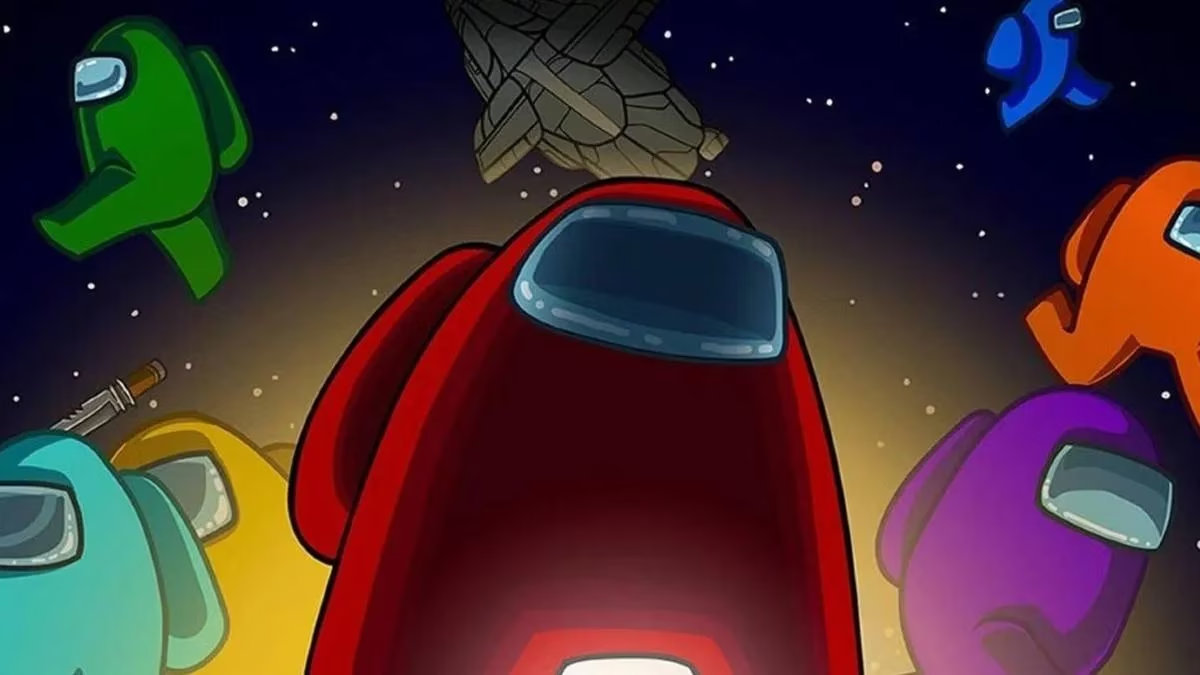
Nobody knew what to expect. The game’s lore was deliberately sparse, a blank canvas for emergent player stories rather than a scripted saga. Could a manga capture the tension of Sunday afternoon betrayal without feeling forced? I picked up that first issue on a whim, half-expecting a quick cash-in. What I got instead was a surprisingly clever boarding-school-on-a-spaceship sprint, with a twisty mystery that honored the game’s paranoia while introducing a cast of distinct, memorable beans. Red wasn’t just a suspect; they were a nervous first officer. Black wasn’t just a killer; they were a sleep-deprived engineer with a dark secret. The series took risks, and they paid off.
Fast forward to 2026, and that one-shot has exploded into a three-volume main story, two spin-off miniseries, and a steady stream of digital-exclusive chapters that fill in the gaps between emergency meetings. The manga didn’t just adapt the game — it reverse-engineered a mythology that InnerSloth themselves have started to embrace. Last year, during the game’s massive “Fungus Among Us” update, developers quietly inserted references to characters and factions first introduced in the manga. The Impostor homeworld, a concept barely hinted at in the game’s original trailers, got a name — Mycelium Prime — pulled directly from the pages of volume two. It’s a rare case of a licensed comic becoming canon, and it has deepened the experience for millions of players.
| Year | Manga Release | Key Event |
|---|---|---|
| 2022 | Debut chapter in Bessatsu CoroCoro | Introduction of core crew: Red, Cyan, Black |
| 2023 | Volume 1 collected, spin-off “Vent Tails” begins | First canonical mention of the Skeld’s AI, O2 |
| 2024 | Volume 2, “The Polus Incident” arc | Mycelium Prime lore expansion |
| 2025 | Volume 3 finale, anime adaptation announcement | Crossover with Among Us VR limited event |
| 2026 | Spin-off “Mira HQ Diaries” running | Upcoming Netflix animated series integration |
I can’t talk about the manga’s longevity without mentioning the VR revolution. Shortly after that first chapter dropped, InnerSloth teased a virtual reality version of Among Us at the Game Awards. By late 2023, Among Us VR had launched, and suddenly the sweaty-palm experience of watching a fellow crewmate twitch suspiciously in a 3D hallway was real. The VR game didn’t just adapt tasks; it introduced exclusive roles that later bled into the manga. The Phantom imposter class, capable of short-range teleportation, became a central mystery in the “Mira HQ Diaries” spin-off. Playing the VR game now, with the manga’s lore running through my head, every vent creak feels like a footnote in a much larger story.
Perhaps the cleverest move was how the manga handled silence. In a game where quick chat and frantic meetings define the flow, the comic had to invent an internal monologue system. Crewmates could communicate via helmet-to-helmet link, but the Impostor could jam those signals — a mechanic directly inspired by the sabotage system. This visual storytelling trick, showing a character’s dialogue bubble dissolve into static just as they’re about to reveal a crucial clue, became iconic. It’s now the logo for the official Discord server, and fans still post screenshots of those static-filled panels whenever a server goes down during a critical vote.
Looking at the Among Us transmedia landscape today, it’s clear the manga was the foundational piece. Without it, the Netflix animated series announced in late 2025 would have had to build everything from scratch. Instead, the show’s showrunner cited volume one as their “bible,” and early teasers feature the exact same character designs and rivalries. The voice cast — a brilliant mix of streamers and professional actors — leans heavily on the manga’s established personalities. I’ve seen casting decisions hotly debated based on how well they “fit” the comic’s version of Cyan’s deadpan sarcasm or Brown’s puppy-dog enthusiasm.
I asked a friend who works at a comic shop how the trades are selling. “It’s not just kids,” they told me. “Adults come in because they remember playing during lockdown, and now they want to know why their friend Steve always acted so guilty.” That’s the secret sauce, really. The manga gave a generation of isolated gamers a new way to engage with a world that had kept them connected, and in the process, it turned a simple social deduction game into a narrative powerhouse. Four years on, I’m not just running tasks and calling out bodies — I’m walking through a living story where every suspicious glance and every emergency button press carries the weight of dozens of issues. And I wouldn’t have it any other way.
Insights are sourced from VentureBeat GamesBeat, whose industry reporting helps frame why transmedia expansions like the Among Us manga can evolve from a simple adaptation into a pipeline for broader canon-building. Seen through that lens, the blog’s timeline—from the 2022 debut chapter to spin-offs and VR-to-manga role crossovers—reads like a deliberate strategy: test narrative hooks in print, validate engagement with ongoing digital chapters, then scale the strongest characters and lore into larger productions such as an animated series, where consistent designs and established rivalries reduce creative risk while amplifying fan investment.