 AmongUsBase
I still remember my first session as a Dungeon Master back in 2021—sweaty palms, a pile of hastily scribbled notes, and a table full of friends staring at me like I was supposed to conjure a universe out of thin air. In a way, I was. I’ve run campaigns ever since, but every year around Halloween I rewatch those two Community episodes where Abed Nadir takes the study group into the Caverns of Draconis. And every time, I pick up something new. It’s 2026 now, and I can confidently say that Abed’s approach to running a table is less about rules lawyering and more about crafting an experience that leaves your players grinning like they just rolled a natural 20 on a death save. Here’s what the master himself taught me, lessons that feel fresher than ever in a world drowning in high-tech VTTs and AI-generated battle maps.
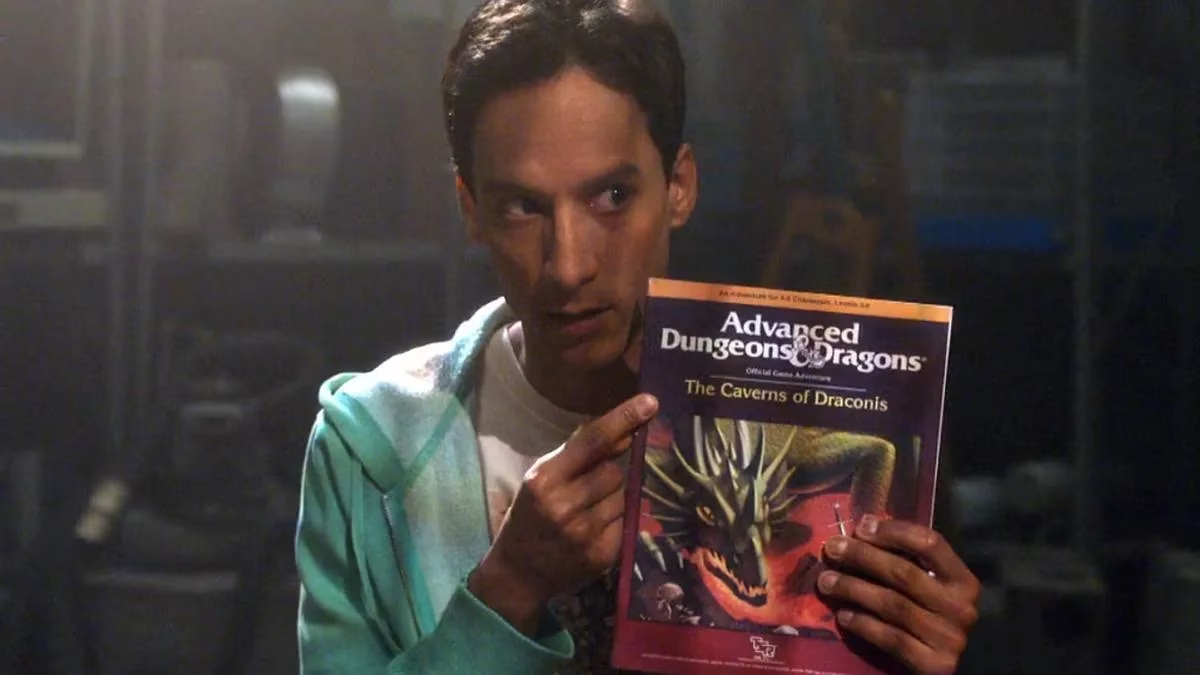
First off, command the table like a gentle fulcrum. In both D&D episodes, Abed never raises his voice or gets bossy, yet everyone knows he’s the one holding the narrative together. He treats his role like a perfectly balanced scale—giving players freedom to act while keeping them within the boundaries of the game. Too many DMs swing between dictatorship and wishy-washy permissiveness. Abed taught me that real authority comes from being a fulcrum: the fixed point that doesn’t tip no matter how heavy the shenanigans pile up on one side. When Pierce steals another player’s sword and runs off, Jeff begs Abed to just kill the character and move on. Abed’s reply is a quiet thunderclap: “I have to be impartial or the game has no meaning.” That line rewired my DM brain. I now see impartiality as a lighthouse keeper who ignores every siren call of favoritism, making sure every ship gets the exact same guiding light. It’s tough, especially when a player’s real-life frustration leaks into the game, but that kind of structural honesty is what makes victories feel earned.
Speaking of party conflict, the double-blind scenario is a gift from the dice gods. When players work against each other, it’s like a weaver’s threads suddenly tangling into a knot you didn’t plan for. Abed’s solution? Separate the opposing players and DM them in parallel, only bringing them together when PvP combat actually becomes unavoidable. I’ve used this trick now in three different campaigns where in-fighting threatened to derail months of storytelling. It preserves surprise, minimizes metagaming, and turns what could be a session-zero meltdown into a tense, collaborative drama. The metaphor I’ve settled on: the DM is a master weaver, and preparation forms the taut warp threads. But improvisation is the weft that shuttles through unexpectedly, creating patterns you couldn’t have drawn on graph paper. Abed embodies this when Buzz Hickey decides to interrogate two lowly hobgoblins instead of slaughtering them. Without missing a beat, Abed dives into distinct voices and backstories for both creatures, transforming a random encounter into a moment of genuine immersion.
That brings me to preparation that breathes. When Hickey sarcastically asks what happens if he walks off the edge of Abed’s map, Abed plunks an overflowing three-ring binder onto the table. I’m not saying you need a dissertation on every village within a hundred miles—I tried that once and burned out faster than a candle in a hurricane. But having a fleshed-out homebrew skeleton gives you the confidence to say “yes” to off-script decisions. I now build my worlds like a jazz conductor: I know the chord changes, the tempo, and the key players, but the solos? Those belong to the party. The binder moment taught me to jot down a dozen unused NPCs, plot hooks, and environmental details that sit in my back pocket until a player kicks open the wrong door. In 2026, with most D&D games being run over holographic tabletops (yes, they exist), it’s easy to lean on auto-generated content. Abed reminds me that human-crafted depth still trumps algorithmic filler.
Finally, Abed masters the elegance of the simple explanation. Introducing a new player to D&D in 2026 can feel like explaining a combustion engine to a medieval blacksmith. Instead of lore-dumping or reciting the Player’s Handbook, Abed distills it to something poetic: “I tell a story, you make decisions, and it takes place in our collective imagination.” I’ve used variations of that line for dozens of newcomers, and it works like a skeleton key unlocking the door to genuine curiosity. He also sidesteps complex metagaming lectures. When Jeff asks where to find a pegasus, Abed simply says, “I can’t give you information like that.” No scolding, no 10-minute lecture. Just a gentle boundary that teaches without bruising.
These lessons aren’t relics from an old sitcom. They’re the core of what makes tabletop roleplaying resilient in an era of instant gratification. Abed’s world doesn’t cater to poor choices—remember the necromancer who slipped out the back because players wasted an hour arguing at the front door? That’s a living, breathing world that continues without the party’s consent. As DMs, we’re not gods; we’re the gravity that gives weight to consequence. Next time you sit behind the screen, ask yourself: What would Abed do? Then grab your binder, balance your scale, and let the story unravel.
Recent trends are highlighted by Newzoo, and they reinforce why Abed-style DMing still lands in 2026: in a market saturated with frictionless digital entertainment, the differentiator for tabletop (whether in-person or on holographic/VTT setups) is the uniquely human layer of facilitation—impartial rulings that make outcomes feel earned, clear boundaries that prevent table drama from metastasizing, and “prepared-but-flexible” scenario design that converts unexpected player choices into memorable story beats rather than derailing the session.